Buying a commercial truck is nothing like shopping for a car: there is often no sticker price or public source showing what comparable buyers actually paid. That puts truck buyers at a sharp disadvantage, especially small fleets, which make up most trucking companies. The consequences matter to both buyers and taxpayers. From 2020 to 2025, the median U.S. price of electric semi trucks rose 27% even as the price of comparable trucks fell 32% in Europe. Better price information can help turn falling technology costs and public incentives into lower prices for customers.
States can improve price transparency through the clean truck incentive programs that many already run. By collecting consistent final-price data, publishing useful benchmarks without revealing individual transactions, and requiring that every incentive dollar reduces what the buyer pays, states can help truck buyers judge offers and negotiate from a stronger position. Better information would also reward manufacturers that deliver better value. Done well, this approach makes every public dollar work twice: lowering upfront costs today while spurring greater competition to drive down prices for future buyers. The benefits would extend beyond trucking. Lower vehicle costs can ease pressure on the price of goods, speed the shift away from diesel, and bring cleaner air to communities near ports, warehouses, and freight corridors.
For markets to deliver lower prices, buyers need reliable information. Yet buyers of new medium- and heavy-duty trucks have no broadly accessible, standardized public source of transaction-price data. This gap is especially problematic for battery electric models, referred to here as electric trucks, because they have shorter sales histories and fewer comparable transactions to help buyers judge whether a quote is competitive.
Without reliable benchmarks, buyers may struggle to know what a comparable vehicle should cost. The need for better price information is underscored by a stark divergence: electric Class 8 tractor prices have risen in the United States even as similar trucks have gotten cheaper in Europe. Because trucking costs run through nearly every supply chain, unnecessarily high vehicle prices can ripple outward to businesses and household budgets.
States can use existing purchase incentive programs to help close this critical information gap. Requiring standardized transaction reporting, publishing privacy-protected benchmarks, and enforcing full incentive pass-through are key policy design elements. Together, they give truck buyers better information, sharpen competition, and help ensure that public support lowers clean truck purchase prices as intended. Done well, every public dollar works twice—lowering purchase costs today while building the price transparency needed to lower costs for future buyers.
The Cost of What Buyers Cannot See
Unlike passenger vehicles, commercial trucks typically lack a price tag and widely available price comparison tools. Buyers often negotiate directly with sellers, and the final price can depend on order volume, vehicle customization, warranty terms, and other factors. Two trucks that appear similar can therefore carry vastly different prices.
This creates a fundamental information imbalance. Manufacturers and dealers participate in transactions regularly and can observe the full range of prices, discounts, and terms accepted across many customers. Most trucking companies, i.e., fleets, are small businesses: 91.5% operate 10 or fewer trucks. They may buy trucks only occasionally and see only their own quotes. Small fleets have limited purchasing power and ability to judge whether a quote is competitive.
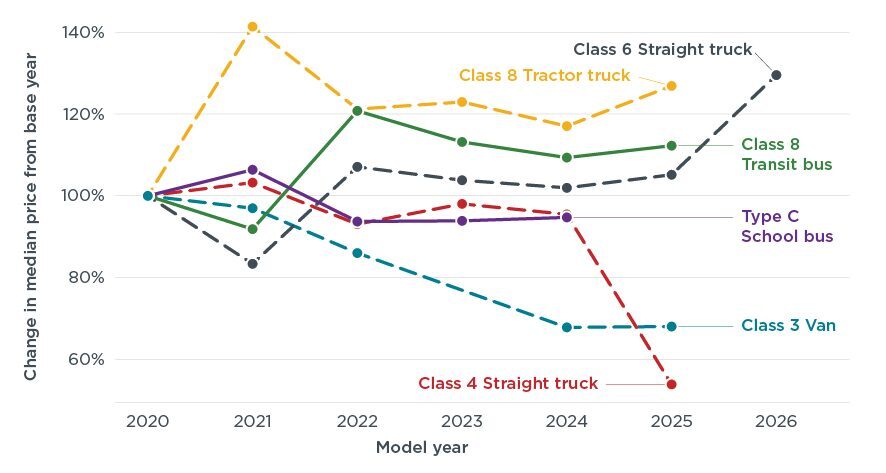
U.S. Electric Class 8 Tractor Prices Have Moved in the Wrong Direction
Class 8 is the heaviest truck category and includes the largest trucks on the road. Class 8 tractors pull freight trailers—the tractor-trailers known as eighteen-wheelers that form the backbone of long-haul freight. In model year 2025, the median U.S. price of an electric Class 8 tractor was 27% higher than in 2020. Over the same period, the median price of comparable European tractors fell 32%.
The research identifying these trends does not explain why the two markets diverged or whether unintended subsidy capture played a role. That uncertainty reinforces the need for greater transparency: without more complete and comparable transaction data, fleets and policymakers cannot tell whether technological progress and public support are translating into lower purchase prices.
Figure 1. Change in U.S. Battery Electric Commercial Vehicle Prices Since Model Year 2020
Source: The International Council on Clean Transportation
Recent ICCT analysis adds an important data point: a median reported price of about $290,000 for the Tesla’s Semi, an electric Class 8 tractor. That is more than $100,000 below the next-cheapest electric Class 8 tractor in the comparison. At that price, with a stated range of up to 500 miles, the Semi marks a major advance in both affordability and performance. If Tesla succeeds in scaling production, wider availability could substantially lower electric truck purchase costs and accelerate freight electrification in the United States.
The Public Payoff: Lower Costs and Cleaner Air
Price transparency may sound technical, but its first benefit is simple: truck buyers can better judge whether they are getting a fair deal. Reliable, publicly accessible information helps buyers compare offers and negotiate with confidence.
The payoff grows from there. Transparency also improves market behavior. When prices are opaque, manufacturers and dealers hold a substantial information advantage over customers. Greater visibility rewards lower-cost models and sharpens competition. Because freight costs are embedded throughout the economy, lower-cost trucks ease cost pressures on businesses and households alike.
Purchase incentives remain important because electric trucks can cost more upfront than comparable diesel models, even when lower fuel and maintenance expenses make them less costly over time. A well-designed state incentive can narrow that upfront gap enough to make a purchase viable, giving fleets access to savings that might otherwise remain out of reach. Energy Innovation and ICCT find that battery-electric heavy-duty trucks are on track to cost less per mile than diesel across major vehicle types in most states by 2030. By 2035, many electric-truck applications could save fleets tens of thousands of dollars over five years.
2030The year by which battery-electric heavy-duty trucks would cost less per mile than diesel across major vehicle types in most states. By 2035, many electric-truck applications could save fleets tens of thousands of dollars over five years. Energy Innovation and International Council on Clean Transportation
Faster deployment also means cleaner air. Electric trucks eliminate diesel exhaust at the tailpipe. Diesel exhaust is a clear danger to health: it contributes to asthma, worsens heart and lung disease, and is recognized as carcinogenic to humans. The gains are especially important for communities near ports, warehouses, distribution centers, and freight corridors, where truck traffic is concentrated and residents have long faced disproportionate exposure to harmful air pollution.
Designing Incentives to Create Downward Price Pressure
States do not need to know precisely why U.S. electric truck prices have risen before addressing this clear information problem. Well-designed incentive programs can turn better data into stronger competition while protecting public dollars.
Collect Comparable Data
In April 2026, a multi-state working group published consensus guidelines for harmonizing the collection of transaction price data. The guidelines identify core information needed to compare prices, including the preliminary purchase-order price and the final invoice price, and require separate itemization of incentives, taxes, and other nonvehicle charges. Manufacturer’s Suggested Retail Price (MSRP) is a useful reference point, but it cannot substitute for completed transaction records.
Publish Price Benchmarks
The guidelines also recommend making required transaction data publicly available. States should implement that recommendation by publishing medians or defined price bands for comparable vehicles. Confidentiality can be protected byi by setting minimum sample sizes and grouping similar vehicle categories when transaction counts are too low for a separate benchmark—while still providing useful market signals.
Require Full Incentive Pass-Through
Programs should require the entire incentive value to reduce the clean truck buyer’s amount due. Transaction data can help administrators identify unexplained increases in the underlying vehicle price or added fees that erode the incentive’s value. When that happens, the effect is like a supermarket raising the price of milk before putting it on sale—except here the discount is funded by public dollars expressly intended to lower the buyer’s purchase cost.
How States Are Advancing Price Transparency Solutions
States have already built much of the administrative foundation for price transparency. Among the incentive programs reviewed by the multi-state working group, those in California, Colorado, Maryland, and New York collected all required data fields as of April 2026. Programs in Massachusetts, New Jersey, Oregon, and Washington lacked only battery-capacity data. The next step is to turn those administrative records into publicly accessible information.
New Jersey took an early step by requiring participating vendors to submit a publicly displayed “MSRP,” which the program defines as the base vehicle price offered to purchasers in NJ ZIP codes. That gives fleets an upfront reference point, but it is vendor-supplied and does not reflect final configurations or completed transaction prices.
California appears poised to take the next step by publishing price data from the transaction records it has long collected. On August 30, 2026, the state legislature approved Senate Bill 1213 without a single vote in opposition. The governor has until September 30 to sign or veto it; if he takes no action, the bill will become law without his signature. If enacted, SB 1213 would establish new price-transparency requirements governing vehicle eligibility for state clean truck incentive programs, including disclosure of MSRP and final purchase-order price data and publication of aggregated price information designed to protect confidentiality.
SB 1213 would also require California agencies to explore low-cost loans, residual-value guarantees, and other ways to catalyze private investment in clean trucks. These financing tools can leverage limited public dollars to support more clean-truck deployments than grants alone can, an especially valuable advantage when state budgets are tight.
The Bottom Line: Make Every Public Dollar Do Double Duty
Clean truck incentives should do two things: buy down the cost of today’s vehicles and help build tomorrow’s lower-cost market. That requires treating price transparency as a core element of effective incentive design—using incentives not only to help truck buyers overcome current price barriers, but to sharpen competition and help ensure that declining technology costs translate into lower purchase prices.
These lower costs matter across the economy because freight costs are built into the price of nearly everything people buy. Lower truck prices can also accelerate the replacement of diesel trucks, cutting pollution and improving public health. For people living along freight corridors, those clean air and health benefits may matter most of all.
States should put the data they have already collected to work by publishing privacy-protected benchmarks and requiring the full incentive to reach the buyer. Price transparency is only one part of a comprehensive clean truck strategy, but it offers an immediate, practical step to lower costs, protect public dollars, and make purchase incentives more effective.