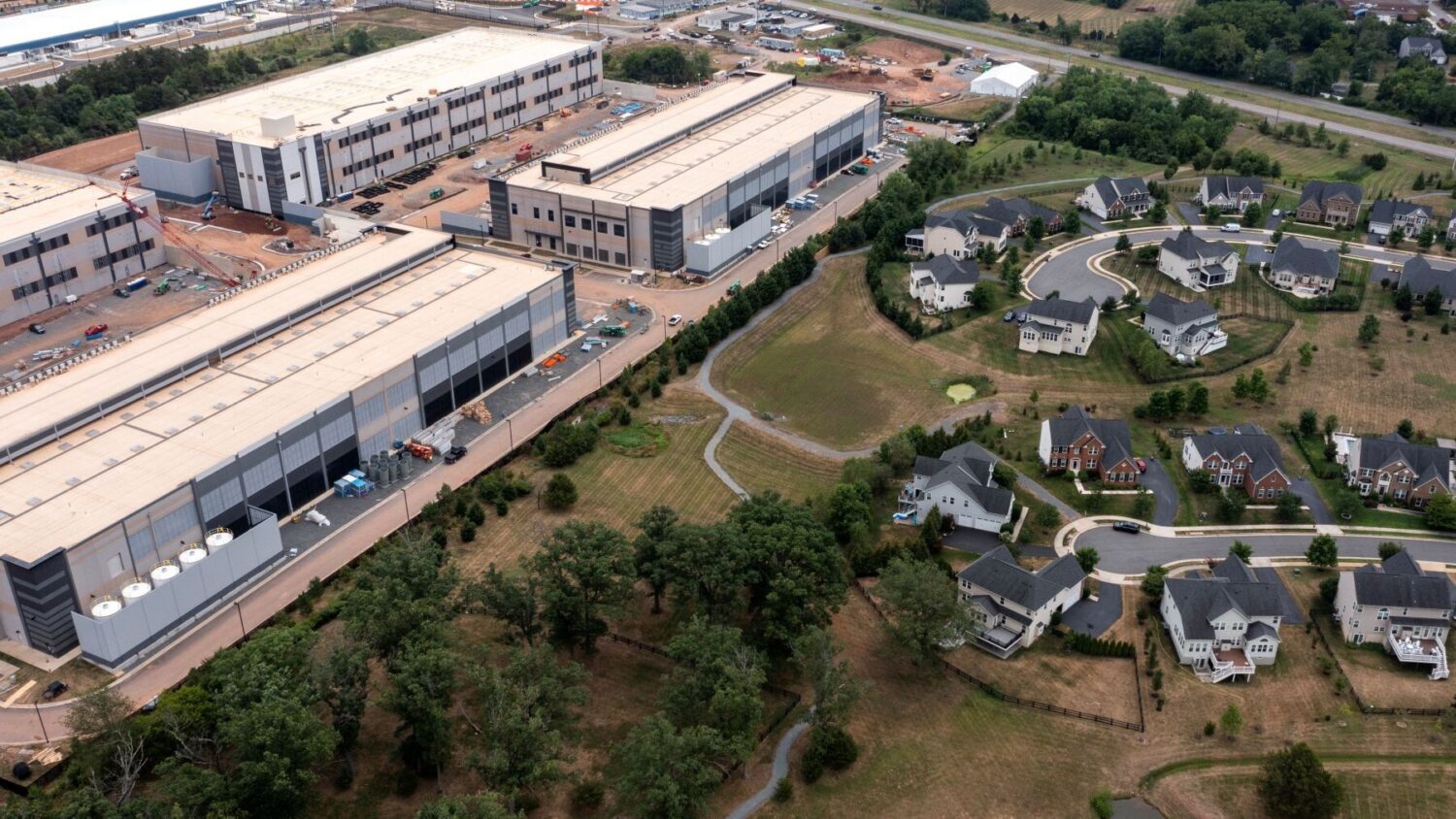
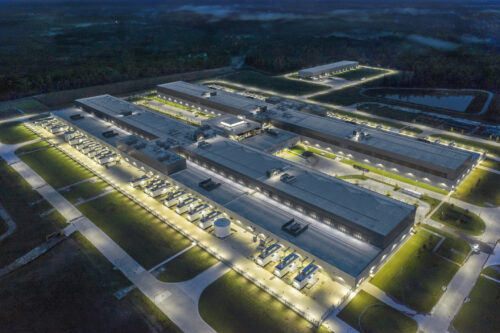
The data center buildout is racing ahead to meet AI demand, but standards and guardrails haven’t kept up. Data centers are putting unprecedented strain on an aging electric grid and fueling fast-growing community opposition. Electricity bills are rising almost everywhere, which puts energy affordability at the center of the debate. If the boom is going to continue, it has to align with the guiding principles below and policymakers need to meaningfully push for data center regulations.
Oct 8, 2026
8 Policies States Can Leverage to Promote Responsible Data Center Development
AI must be regulated. The surge in proposed large-scale data centers is driven by Big Tech’s huge appetite for computing power from artificial intelligence (AI). AI is becoming more useful—and dangerous. It is being built into weapons and poses a major threat to global cybersecurity. It can be a force multiplier for bioterrorism and other attacks, and it can help autocratic governments surveil their citizens. As it becomes more and more autonomous, it risks escaping human control, with unknown consequences. It also threatens to disrupt the economy and further tilt the balance against many types of workers. For these reasons, Evergreen Action believes national and international standards are necessary to reduce AI’s risk.
Communities must come first. Data centers have become unpopular fast, and this opposition unites Americans across the political spectrum. Some of it stems from growing skepticism of AI. Some stems from legitimate concerns about electricity prices, noise and air pollution, and strain on local resources. But much of the backlash comes from how developers have treated host communities. Developers must prove their value to potential hosts and minimize the costs and risks they impose. Data centers should be developed collaboratively and transparently.
Data centers should not raise household electricity bills. Good policy assigns costs to whoever causes them. In some places, data centers are actually loweringcosts for other customers. But in many places, that isn’t what’s happening. Fixing this requires binding, enforceable standards that hold the industry accountable for its promise to lower household electricity costs.
Data centers should be taxed. The era of state tax credits and other subsidies to lure data centers should be over. It’s time to tax data centers instead—their energy use is the logical place to start. Evergreen Action supports state-level taxes and will push for federal taxation to ensure the data center boom helps pay for the clean energy and transmission buildout needed for an affordable, clean, reliable grid.
Here are eight policies state leaders can adopt right now
Establish a large load tariff or special utility rate class for data centers.
Data centers use so much electricity that they should be treated as their own class of customer. Large load tariffs ensure hyperscale companies pay their share of the new generation, transmission, and distribution costs their facilities create. That way residential and commercial customers don’t get stuck with the bill.
A large load tariff should set the contractual basics, including:
Establish a definition: Define by law what counts as a “large load customer,” in megawatts. If the tariff is meant to apply specifically to data centers, explicitly say that.
Set a minimum contract period: Lock data centers into a legally binding period during which they must pay for electricity. Some tariffs include a “ramp-up” period to account for electricity used before a facility is fully operational. Evergreen recommends setting a 15-year minimum contract period.
Define minimum billing: Set a data center’s legally binding minimum electricity charge, usually monthly. Some existing state requirements range from 60-90% of contracted demand. Evergreen recommends states adopt policy requiring at least 85% of contracted demand.
Establish collateral: Require financial guarantees if a project is abandoned, delayed, or defaults on its contract.
Set exit fees: Charge a fee when a data center terminates operation before the end of its contract term. Evergreen recommends that these fees cover the remaining cost of the infrastructure built to serve it that has not yet been fully depreciated.
States should also consider:
Incentives or requirements for demand flexibility (see policy 3).
Incentives or requirements for clean backup power, such as battery storage paired with on-site solar or wind.
Incentives or requirements to maximize energy efficiency.
Establishing a clean transition tariff (a separate rate class designed specifically for procuring clean energy)
Require data centers to bring their own new clean energy (BYONCE).
Many data center companies are proposing or building new gas plants to power their facilities. These plants can harm the health and well-being of nearby communities and lock in decades of added pollution. Data centers should be required to buy their own new clean energy, either directly from a utility or by contracting with a developer to build their own new clean generation. That will help protect communities and add clean energy capacity to the grid when it’s needed most.
BYONCE provisions can be built into a large load tariff, as New Jersey did, or set up as a separate tariff class designed specifically to incentivize data centers to procure clean energy. Either way, states should require a set share of a data center’s energy to come from clean sources.
That clean energy generation must be:
Additional: Hyperscalers should bring new clean capacity online and not take credit for existing resources.
Local: It should be generated in the same region of the grid as the facility. A region can be defined by utility service territory, a local balancing authority, or a regional transmission organization (RTO).
Hourly matched: Data centers should get credit only for clean energy generated in the same hour they use it. This leverages resources that shift electricity consumption from times of high demand or high cost to times of low demand or lower cost, such as battery storage. It also encourages the market to build emerging “clean firm” power—low-carbon generation sources that don’t rely on the weather—such as long-duration storage, geothermal, and nuclear.
States should consider:
Setting a 100% clean energy target for new energy procured by data centers. If 100% isn’t immediately politically, logistically, or economically feasible, consider setting a target that ramps up over time (e.g., 70% by 2035, 85% by 2045).
Requiring data center energy purchases to align with a state’s renewable portfolio standard (RPS), if it has one, or carbon-free goal.
Putting strict limits on on-site or behind-the-meter natural gas generation to power data centers.
Require data centers to embrace flexibility.
“Demand response” programs let customers voluntarily cut their electricity use during peak demand or grid stress. A recent Duke University study found that if data centers cut their energy use during peak hours, they could reduce overall system costs by $40 billion to $150 billion over the next five to 10 years. That saves both data centers and households money. Flexibility also reduces the need for new energy generation and reduces the reliance on natural gas.
When the grid is strained, data centers should curtail their energy usage first, ahead of households and other utility customers.
When advancing legislation, state policymakers should consider:
Requiring data centers to participate in demand response programs, with fossil-fueled resources excluded.
Options for data centers to collaborate with other customers and third-party companies.
Incentives to speed up interconnection for facilities that embrace flexibility.
Incentives for using clean backup power or onsite storage.
Strategies to encourage data centers to invest in virtual power plant programs.
Local governments and developers should sign Community Benefit Agreements.
Community Benefit Agreements (CBAs) make sure residents benefit from a data center and are not harmed by its development. Specifically, they outline legal parameters to limit noise, light, water pollution, and other public health and safety impacts.
Communities should ask for more, and state and local governments should back them up. A data center is a $40 billion to $60 billion investment that is typically expected to yield a healthy profit. Yet the construction of these facilities doesn’t create nearly as many permanent jobs as an investment of that size normally would. CBAs are a way data centers can show they’re willing to share that value with the communities that host them.
CBAs should be legally binding, managed by the local government, and negotiated openly with the community. States should prohibit data center developers from using non-disclosure agreements. And negotiations should be completed during the land development process in no more than a year. Once approved, the agreement should be posted publicly online.
Local ordinances and zoning laws may already cover some of these issues, such as noise and light pollution restrictions. They can be amended to include data centers.
A strong CBA should include:
Minimum wages for employees (“prevailing wage” standards are recommended).
Hiring and job creation targets for both construction and permanent jobs.
Information on workforce training programs and apprenticeships.
Ways to fund community investments.
Strict limits on noise, light, and water use with reporting mechanisms.
A plan for engaging stakeholders.
Require data center projects to establish project labor agreements.
A project labor agreement (PLA) is a “prehire collective bargaining agreement with one or more labor organization that establishes the terms and conditions for employment for a specific construction project.” They help set labor and employment standards to ensure workers are paid a prevailing wage and receive appropriate benefits. They can also set worker safety standards, create training and apprenticeship opportunities, and establish rules for conflict disputes.
Across the country, some data center PLAs are being negotiated as part of CBAs, but states can also pass strong labor protections through legislation. Writing labor protections into law sets a statewide standard so that local governments don’t have to establish them project by project.
Require investments in community energy funds.
Under this approach, money from an upfront fee or tax on data centers goes into a community energy fund managed by the state. Some states, for example, tax data center electricity use and the revenue goes into a similar fund. Evergreen recommends using the money to upgrade community energy systems, including:
Home upgrades such as energy efficiency, weatherization, and installing solar and batteries or smart appliances.
Electric vehicles and charging infrastructure that can send power back to the grid.
New or existing virtual power plant programs to help balance the grid during peak demand or grid constraints.
Community solar projects to help more customers get bill credits from solar energy generation.
A CBA can also determine how the money is invested.
Fast-track interconnection for data centers using clean energy and make them pay for related grid upgrades.
More and more states are looking for ways to speed up data center interconnection so facilities can connect to power faster. During the interconnection process, the utility and grid operator study how a facility will impact the grid, what system upgrades it needs, and what they will cost.
Data centers should pay for the network, transmission, and other infrastructure needed to connect them. States should let data centers speed up interconnection or jump the queue only if they bring clean behind-the-meter resources, add new clean generation to the grid, or commit to being flexible. Data centers bringing new natural gas plants online should not delay projects already in the queue.
Pass comprehensive AI regulation for the responsible development of the technology.
Evergreen is not an AI safety organization. But as AI leaders themselves sound the alarm about the technology, policymakers must put guardrails in place so it’s developed responsibly. AI regulation must ultimately happen at the federal and multinational levels, but state leaders are closest to the growing opposition to data centers and the realities of building them. They will play an important role in making it clear that AI regulation is needed and federal policymakers need to act.
At a minimum, that means:
Requiring AI risk assessments.
Protecting consumers and users.
Holding companies liable for rogue incidents.
Passing strict data privacy laws.
Adopting strategies to limit job losses.
Policymakers should work to limit the negative economic and societal harms of AI while encouraging uses that increase overall societal wealth and well-being.