This paper offers a first-of-its-kind dataset and map of 14,000 industrial boiler units in all 50 states and Puerto Rico, including data on the criteria and hazardous air pollutants they emit. It outlines the legal authority states have to set emissions limits on industrial boilers, the costs and benefits analysis for them to do so, and case studies of what boiler electrification can look like in practice.
This paper is a tailored resource for regulatory agencies, state policymakers, and local advocates who can seize this tremendous opportunity to lead on climate action, tackle a major source of hazardous pollution, protect community health, and advance environmental justice.
The solutions proposed in this paper are cost-effective and immediately deployable. The lifetime pollution reduction benefits from replacing gas-fired boilers with heat pumps outweigh the upfront costs in the vast majority of cases. Decarbonizing industrial boilers offers a savvy, effective win for policymakers while delivering life-changing benefits for frontline communities.
May 28, 2025
Trevor Dolan, Andres Restrepo, Cassandra Lopina, Melanie Law, and Madison Carroll
Enter Your Email To Download PDF
Additional Downloads
Boilers Drive Industry Pollution Boilers drive major CO2, NOx, and toxic emissions that harm local health and climate.
Low-Heat Ready for Electrification Most heat demand is below 500°C, where electric tech can replace gas today at scale.
Boilers Burden Disadvantaged Areas Over 40% sit in DACs, with higher average NOx and toxic emissions than non-DAC communities.
Heat Pumps Deliver Efficient Cuts Lifecycle CO2 reductions often outweigh added costs under current policy signals and incentives.
Industrial boilers, though often overlooked, are a significant contributor to air pollution in the U.S. The widely used technology, essential to industrial sectors like food production, pulp and papermaking, and chemical manufacturing, overwhelmingly relies on fossil fuels. This dependence makes boilers responsible for up to 10 percent of all industrial carbon emissions and 6 percent of all industrial NOx pollution, posing a serious threat to both our climate and public health.
Boilers also emit a toxic cocktail of pollutants, including PM2.5, NOx, mercury, lead, formaldehyde, and hydrochloric acid, into neighboring communities. Forty percent of all industrial boilers, and a staggering 66 percent of the highest-emitting ones, are located in federally recognized disadvantaged communities. These are often communities of color, facing the compounded burdens of poverty, high unemployment, and significant pollution.
As domestic manufacturing continues to grow, boiler pollution and its inequities will grow too, if state and federal leaders do not intervene. Fortunately, we currently have the technology needed to electrify industrial heat, and states have the full authority under the federal Clean Air Act to issue more protective air pollution standards immediately.
The reconciliation package included a number of measures to spur fossil fuel development on federal lands, including removing agency discretion to deny federal leases based on environmental, private land, or community concerns, and lowering the royalty rates on oil leases while eliminating them from gas leases altogether.
Industrial Boiler Landscape
Comprehensive and reliable data on industrial boilers, particularly with respect to emissions of criteria and hazardous air pollutants, have remained incomplete, and the data that exists has been difficult to utilize at the equipment level. Building on work from Energy and Environmental Analysis, Inc. (E3), CAELP, Northwestern University, and UC Santa Barbara, we have sought to fill those gaps by developing a first-of-itskind emissions dataset for the full fleet of U.S. industrial boilers, with nearly 14,000 boiler units and the conventional pollutants they emit.
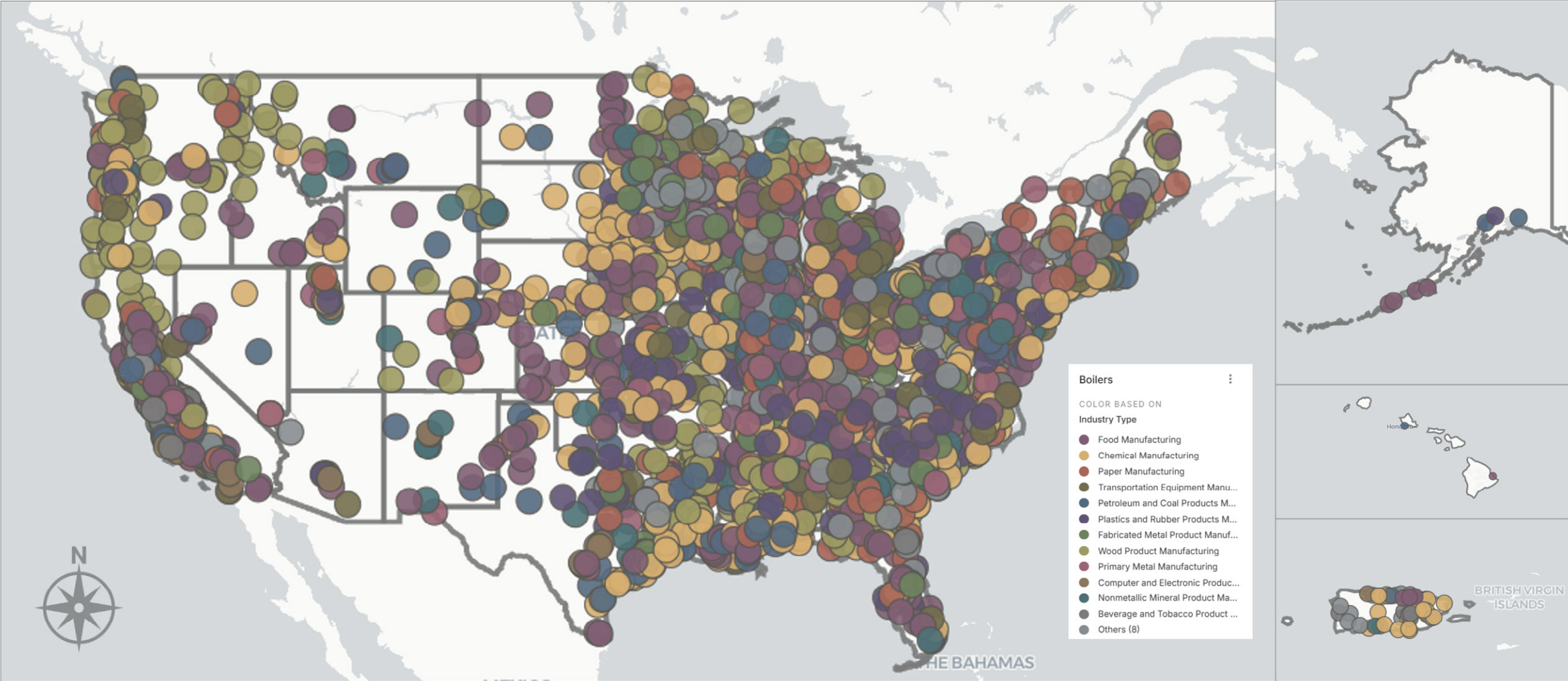
This refined dataset is visualized in an online interactive National Map of Industrial Boilers, designed to empower national, state, and local efforts to understand the geographically distributed environmental impacts of the current industrial boiler fleet as a first step in mitigating those emissions. The map’s dynamic features allow users to filter and explore the data by various parameters such as state, fuel type, subsector industry, unit capacity, and proximity to environmental justice communities, facilitating targeted analysis of emission trends.
Online Interactive National Map of Industrial Boilers (number of boilers by subsector)
Emissions Impacts of the Existing Boiler Fleet
This section of the full report provides new insights into criteria pollutants from U.S. industrial boilers, building upon the advancements in characterizing the U.S. industrial boiler fleet achieved in the 2022 Northwestern/UC-Santa Barbara study.6 In this section we will also introduce our own research to further explore emissions of criteria air pollutants (i.e., those regulated under EPA’s National Ambient Air Quality Standards (NAAQS) program) and HAPs from boilers.
We first provide a brief overview of the GHG emissions generated by the U.S. boiler fleet, relying on data from the Greenhouse Gas Reporting Program (GHGRP) as evaluated by a recent analysis issued by the Center for Applied Environmental Law and Policy (CAELP). We then offer a discussion of the conventional and hazardous air pollutant impacts from these units. Our disaggregated analysis of NEI data allows for a more precise understanding of the geographically distributed air quality impacts and public health burdens associated with these emissions, providing a crucial foundation for evaluating the benefits of transitioning to cleaner, electric alternatives discussed later in the report.
Major Technologies for Industrial Boiler Electrification
Legacy fossil-fueled boilers are a significant source of GHGs, criteria air pollutants, and HAPs, contributing to climate change, exacerbating public health problems, and worsening ongoing environmental injustices that afflict vulnerable populations. But technology exists now that can effectively mitigate this pollution while revitalizing and future-proofing the U.S. manufacturing sector. Regulators, lawmakers, and advocates must prioritize the transition to boiler electrification— the replacement of combustion-based systems with clean, electric alternatives. This section of the full report provides an in-depth analysis of electric heat pump and boiler technologies, acknowledging that the options discussed herein are only some of a larger constellation of alternatives to combustion boilers that are available on the market or currently in development.
The remainder of this section will explore the technical capabilities, technology readiness levels, availability, and capacities of two key electric alternatives to combustion boilers—heat pumps and conventional electric boilers—while also offering an overview of thermal energy storage, an emerging and crucial enabling technology for enhancing electrified heat’s economic viability and grid integration. Understanding the current landscape of these clean alternatives is essential to accelerating their adoption and supporting the implementation of new, stringent limits on industrial boiler pollution. This, in turn, can provide significant reductions of both climate and conventional air pollution while helping to cultivate a more modern, competitive U.S. industrial sector.
Emission Reductions and Economic Impacts of Industrial Boiler Electrification
This section of the report will discuss the benefits of emission reductions that can be achieved by electrifying combustion boilers. We also evaluate the associated costs of replacing combustion boilers with electric technologies and compare them against those benefits. Rather than conducting our own independent quantitative analysis of emission reduction benefits and the associated economic costs, we instead compare the findings from a number of recent studies on this very topic, which all point toward a similar conclusion: the substantial majority of heat pumps installed today for industrial thermal needs will be broadly cost-effective at reducing pollution over the course of their operating lives and, in some instances, can actually reduce facilities’ operating costs. The pollution abatement costs remain higher for applications that require temperatures that exceed the current capabilities of heat pumps, but we conclude that electrification in these cases is still justified, particularly where thermal batteries can serve heat storage needs alongside the use of conventional electric boilers.
Policy Drivers for Industrial Boiler Electrification
In this last section of the report, we will provide a brief survey of some of the policy avenues that regulators and lawmakers may consider (and that other stakeholders may advocate for) to help accelerate the pace of adoption of the non-emitting technologies discussed throughout this report—namely, industrial heat pumps, conventional electric boilers, and thermal batteries. This discussion is not meant to be exhaustive, nor are any of the policy options discussed exclusive of one another. Instead, we provide a survey of the kinds of regulatory or legislative tools that may help decarbonize industrial heating processes.