
Overview
Read time:
Public opposition to data centers is growing nationwide. Some state and local leaders are putting new projects on hold or banning them outright, while others are searching for the right safeguards to protect their constituents. These massive facilities power artificial intelligence (AI), and many run around the clock. Their impacts—and the issues they create—reach well beyond the communities where they’re built:
- Data centers use immense amounts of electricity and water.
- The AI these data centers power threatens to displace workers and reshape the workforce completely.
- Experts warn that increasingly autonomous, rogue AI models could launch cyberattacks and even escape human control.
That’s why AI must be strictly regulated at the state and federal levels. And any data centers that do get built must minimize the harm they impose on the communities that host them.
Evergreen believes four principles should guide AI and data center regulation:
- AI must be regulated.
- Communities must come first.
- Data centers should not raise household electricity bills.
- Data centers should be taxed.
What We’re Up Against
Not long ago, state leaders were competing to attract data centers, lured by the promise of construction jobs and tax revenue. With little regulation in place, Big Tech raced to build—and build fast.
Here’s the problem: data centers need a lot of energy. Many of the largest “hyperscale” facilities use more than 100 megawatts (MW) of continuous power—enough to power more than 80,000 homes in a year. This need for power can inadvertently raise electricity prices for other ratepayers in some regions—a fact that rings particularly true within PJM Interconnection, the regional transmission organization that controls and coordinates the nation’s largest electric grid serving 13 states and D.C., including Virginia, a place some have dubbed “Data Center Alley”.
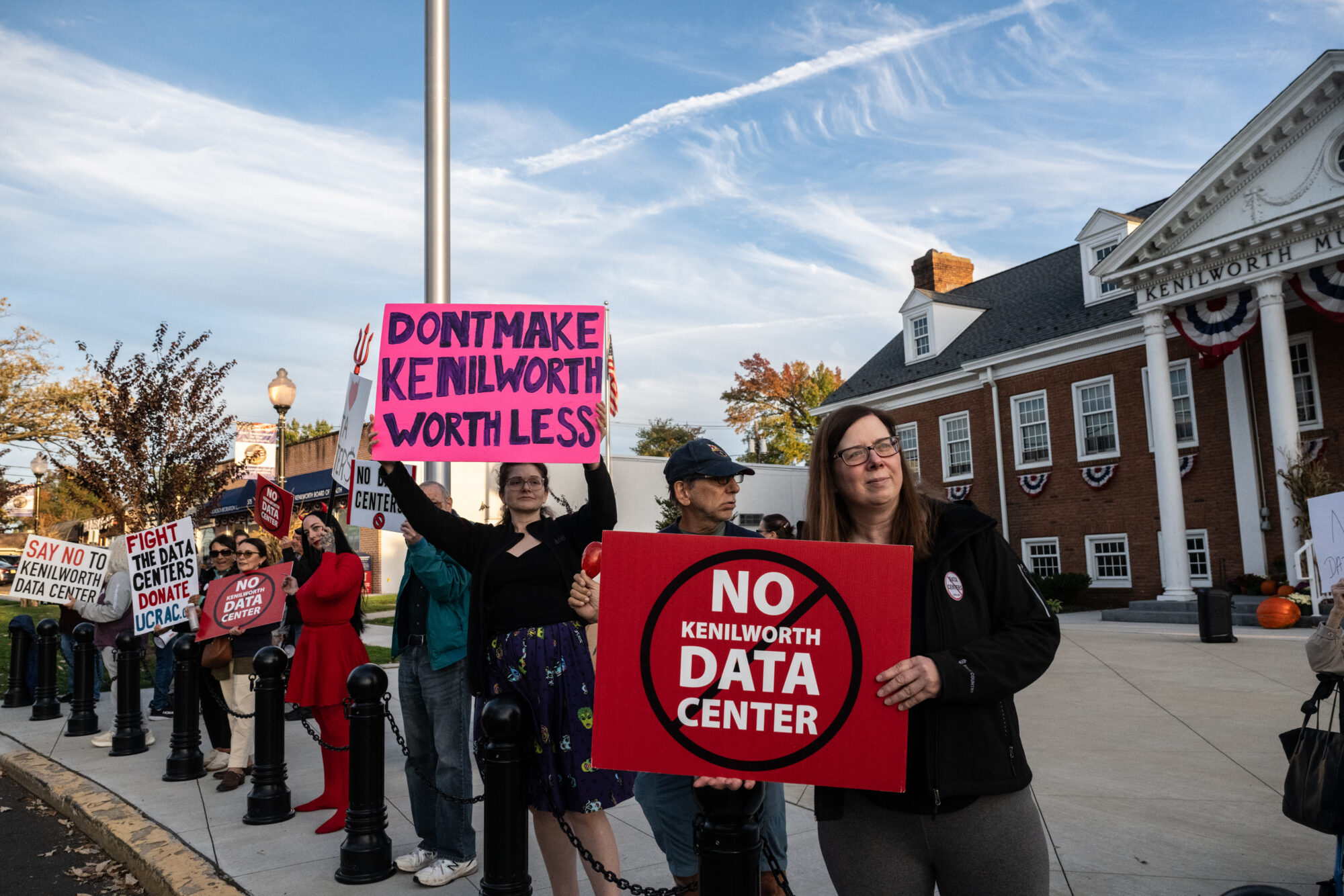
Public opposition to data centers is growing nationwide. Their impacts—and the issues they create—reach well beyond the communities where they’re built. (Photo by Stephanie Keith/Getty Images, October 21, 2026, Kenilworth, New Jersey.)
Because connecting to the grid can take years, many data center companies are building their own “behind-the-meter” gas plants onsite to power their facilities—in one case, in a predominantly Black neighborhood that has long dealt with health-threatening pollution. It’s no wonder communities are fiercely opposed and pushing back hard: regulations simply haven’t kept up.
This upcoming legislative session gives state policymakers a new opportunity to hold Big Tech accountable and set the terms for future data center development.
A Toolkit for Action
As policymakers work to tackle climate change and lower energy costs, data centers must be built in a way that protects our communities and ratepayers. Evergreen Collaborative’s data center state policy toolkit lays out eight policies leaders can adopt right now to make that happen, each paired with a case study of a state that’s getting it right.
Here’s a brief look at the policies included in the toolkit:
1. Make data centers pay their own way on the grid.
Data centers use so much electricity that it’s only fair to other ratepayers to treat them as their own class of customer. A large load tariff—a special electricity rate for the biggest users—requires data center companies to cover any new generation, transmission, and distribution costs they create, so families and small businesses don’t get stuck with the bill.
2. Require data centers to bring their own new clean energy.
Data centers are fueling a rush of new gas plants. According to Global Energy Monitor, gas power proposals linked to data centers nearly doubled in the first half of 2026, to 189 gigawatts. That risks locking communities into decades of new, polluting gas infrastructure, and poses serious health threats to those who live closest to these facilities.
Instead, data centers should be required to buy or build new clean energy to power their operations—a policy known as “bring your own new clean energy,” or BYONCE. These requirements can be included in a large load tariff or set up as a separate clean transition tariff, a rate designed specifically to help large customers buy “clean firm” power—that is, clean energy that isn’t dependent on variable resources and available on demand.
3. Make data centers scale back energy use first when the grid is strained.
When demand peaks or the grid is strained, data centers should be the first to curtail—in other words, reduce their electricity use, ahead of households and other customers to relieve pressure on the grid. One study found this kind of flexibility could lower overall electricity system costs by $40 billion to $150 billion over the next five to 10 years and reduce long-term reliance on fossil infrastructure.
4. Limit data center harms and ensure residents share in their benefits with legally binding agreements.
A Community Benefit Agreement (CBA) is a legally binding contract designed to limit data center harms and ensure residents share in the benefits. CBAs have long been used for other types of development, but data centers are unique because they strain water, power, and local infrastructure all at once. Local governments should lead these agreements and negotiate them openly with community members—no secret deals or nondisclosure agreements.
5. Guarantee good, safe jobs for the workers who build and operate data centers.
A project labor agreement (PLA) sets wage, benefit, and safety standards for the workers who build and operate a data center, including guaranteeing prevailing wages.
6. Make data centers invest in community energy funds.
States should require data centers to pay a tax or fee into a state-managed community energy fund. Those funds can pay for home energy upgrades, electric vehicles and charging infrastructure, virtual power plant programs, and community solar projects. This is a readily available way for data centers to invest directly in the communities that host them.
7. Let data centers powered by clean energy connect to the grid faster, and make them pay for needed grid upgrades.
Before a data center can connect to the grid, it must undergo an assessment of how it will affect the grid, what upgrades it needs, and what those upgrades will cost. With companies scrambling to get online fast, states have leverage: they can let data centers move to the front of the line for connection only if they bring their own new clean energy.
8. Put real, comprehensive guardrails on AI.
AI is advancing rapidly, and experts—including AI developers themselves—are sounding the alarm. The U.S. urgently needs the proper guardrails in place before it’s too late. Setting federal and international standards is crucial, but state policymakers see firsthand how AI and data center development are affecting people. They play a key role in making sure AI is developed responsibly, with the well-being of communities at the center.
Each of these solutions puts into practice the principles that must guide data center development. Data centers, and the AI they power, must be regulated. And as policymakers navigate this fast-moving landscape, the health and well-being of their constituents must come first.
For more detail on each policy and states leading the way, read our full data center state policy toolkit.