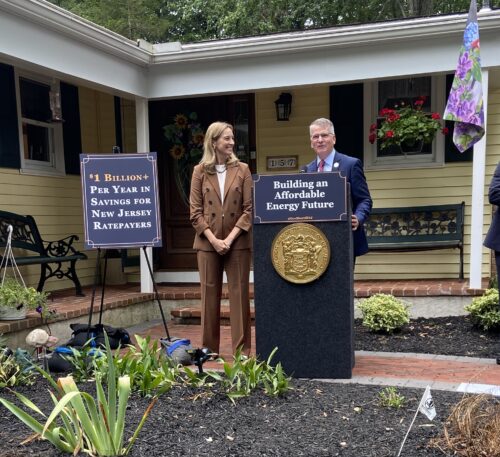
After signing a landmark three-bill legislative package designed to address the structural drivers of New Jerseyans’ energy bills, Mikie Sherrill stands with Asm. Dave Bailey outside the home of the Assemblyman's mother, who experienced soaring energy bills.
A decade ago, states asked how quickly they could deploy clean energy. Today, they’re asking a different question: how can they lower electricity bills in the era of unprecedented load growth and demand?
As part of her work to deliver both immediate and longer-term reforms to reshape New Jersey’s energy systems, Governor Mikie Sherrill signed a landmark three-bill legislative package designed to address the structural drivers of New Jerseyans’ energy bills. She signed the legislation from the kitchen table of Assemblymember Bailey’s mother, whose soaring energy bill emerged as a framing piece of advocacy for Bailey and New Jersey’s affordability crisis. It put a mother’s face to the data: the nearly $400 annual increase in energy costs for the average New Jersey household.
Across the country, states are struggling with record-breaking electricity prices and growing concerns about affordability, and New Jersey was not alone in confronting these challenges during this year’s legislative session. What set New Jersey apart, however, was its willingness to identify and act on the underlying causes of the soaring costs. Rather than treating higher bills as unavoidable, state leaders focused on the structural pressures driving them, including the growing electricity demand from data centers, the many flaws in the PJM electricity market, and tools used to align utility incentives for lowering costs– it was a power system planning challenge.
Three Bills, One Strategy
The three-bill package that was signed into law on July 7, 2026, tackles three of the challenges in New Jerseyans electricity bills head-on.
First, any load growth should pay for itself. New Jersey will be among the first states in the country to require that new data centers shoulder the costs they impose upon the electricity system, and that the generation built to power these large customers be met with clean energy. This bill offers protection to New Jersey families and businesses, ensuring new costs do not shift onto families.
Second, transmission infrastructure should be smarter. This legislation modernizes transmission planning by requiring greater oversight over supplemental transmission projects by encouraging the use of advanced transmission technologies. By asking utilities to consider lower-cost alternatives, consumers will ultimately avoid footing the extra costs on their bill.
And finally, markets should work for customers and not be a place of hand-outs. New Jersey took the important step of mandating transmission owners to participate in PJM, which removes a long-time incentive for these players that has led to increased costs for consumers without the additional value.
What these three bills mean for New Jersey families extends beyond good policy, but it means tangible and delivered savings. Independent modeling by Synapse Energy Economics estimates that each of the policies advanced by Sherrill and enacted this session could reduce electricity costs by addressing the different drivers of the rising bill by an estimated $1 billion statewide. The analysis found that requiring new data centers to bear the costs imposed on the electric system could save the average residential household approximately $137 per year, or roughly $907 million statewide annually. Strengthening oversight of supplemental transmission projects could produce additional savings, while eliminating the PJM return-on-equity incentive adder and extending capacity auction reforms each reduce separate components of customer’s bills.
$907 millionapproximate annual statewide energy savings in New Jersey by requiring new data centers to bear the costs imposed on the electric system Synapse Energy Economics
A Virtual Power Plant Straw Proposal
With strong leadership from the Legislature and the Governor, New Jersey has begun addressing who bears the costs of growing new electricity demand. The New Jersey Board of Public Utilities (NJBPU) is now asking the next logical question: How should utilities plan for tomorrow’s grid?
One of the answers is through virtual power plants– a way for utilities to coordinate customer-owned, behind-the-meter technologies such as smart thermostats, electric vehicle chargers, storage and batteries, and any other flexible energy resources. One of the important features of a VPP is its ability to meet demand increases through existing customer resources rather than building out the costly infrastructure that causes increases on a resident’s bill.
This work fulfills Sherrill’s Executive Order No. 2 (EO2), which directed the NJBPU to not only develop a statewide framework to offer these services to New Jerseyans, but to begin to define the value proposition for customers who choose to participate. Within the Board’s Virtual Power Plan Straw Proposal, the framework recognizes an important principle: the cheapest megawatt is the one that never has to be built.
In energy policy conversations, one phrase repeats itself, and it is this: there is no silver bullet to the incredible demand that the distribution grid faces. The Legislature addressed who should pay for the costs of new demand. The Governor directed necessary agencies to find various solutions on the distribution level. And this VPP Straw Proposal answers that call in recognizing that the resources New Jersey is searching for are already connected to the grid. They just need to be treated that way.
Utility Business Model Reform
Neither legislative reforms nor virtual powerplants will succeed if utilities continue to operate under a business model that incentives capital investment over lower-cost solutions.
At the same time as the VPP Straw Proposal, the Utility Business Model Reform proceeding asks perhaps the most important affordability question of all: What if there was another way to conduct utility business that moved beyond what gets built? The Phase I Report shifts the conversation away from how utilities traditionally recover costs from capital investments– like substations, transformers, poles and wires– toward evaluating whether the same reliability and capacity outcome could be achieved through lower-cost alternatives such as VPPs, demand response, battery storage, or targeted energy efficiency.
Because these alternatives defer or eliminate the need for a capital project, potentially lowering costs for customers, it also challenges the historically rewarded investment in adding more capital to a utility’s rate base, where the utilities are authorized to make returns on their investments.
The goal of this proceeding is not to prevent needed infrastructure upgrades, but to increase the scrutiny on whether or not the right infrastructure is being built. In doing so, this proceeding directly fulfills Sherrill’s Executive Order No. 1 by directing the NJBPU to evaluate the current utility business model and produce reform options in which the lowest-cost solution is equally being evaluated in future utility proceedings, and utility incentives are better aligned with affordability.
From the Garden State to the Rest of the Country
New Jersey now has grown into a leader for how states can confront rising energy costs through thoughtful, balanced policymaking. That outcome did not happen overnight, nor did it happen without compromise. Throughout months of negotiations, Governor Sherrill worked alongside legislators, regulators, utilities, and stakeholders to strike the balance of competing priorities, from providing immediate relief in the form of bill credits to advancing long-term reform in New Jersey’s plans for its electric system.
Those decisions represent a willingness to be decisive rather than delay governance. New Jersey chose to act, in a time where states are still debating whether to take action at all despite mounting public pressure. The Legislature established new protections for ratepayers in the AI-boom. The Board of Public Utilities is advancing directives like virtual power plants and aligning utility incentives with affordability.
If implemented successfully, these reforms can serve as a blueprint for states across the country facing the same challenges: how to protect families from rising energy costs and increased energy demand from large loads, how to modernize the electric grid, and how to support economic growth.
New Jersey is known for what it grows, and this year, it has planted the ideas necessary to bring cost containment to the affordability challenge in electricity bills across the state, demonstrating that affordability and climate are not competing priorities, but complementary when paired together.
Thank Governor Sherrill for Leading on Climate and Clean Energy
Governor Sherrill made energy affordability and climate action central to her vision for New Jersey—and she is proving that bold clean energy leadership delivers for families.
By signing the landmark affordability package into law, she’s showing that tackling the climate crisis and lowering costs can go hand in hand.